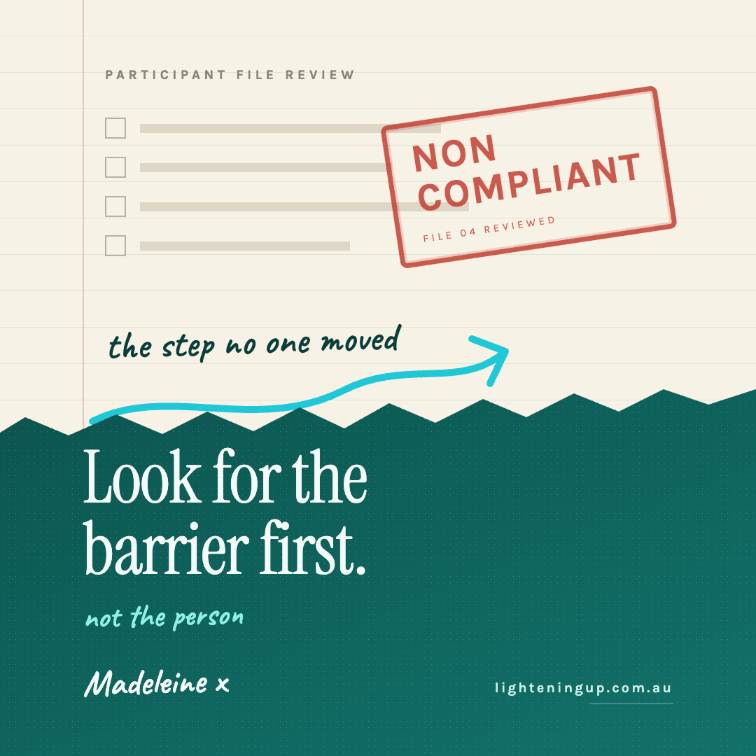
When the System Calls You Non-Compliant, Look for the Barrier First
“Non-compliant.” It’s a word that gets stamped on a file and quietly does a lot of damage. It sounds neutral, almost clinical, like a fact about a person rather than a fact about what happened. Missed the appointment. Didn’t return the form. Failed to follow the process. Case closed, blame handed out, everyone moves on.
Except the story is rarely that simple.
What non-compliance actually hides
Systems blame people when instructions, processes, timelines, or communication were never actually accessible to begin with. A form written in dense, formal language isn’t neutral, it’s a barrier for anyone who finds that kind of reading hard going. A deadline that assumes constant access to email isn’t neutral either, not for someone without reliable internet, or the energy to check it every day. A phone-only process isn’t neutral for someone who finds calls overwhelming, or can’t hear well, or doesn’t have a plan that covers long holds.
Call all of that “non-compliance,” and the problem gets pinned entirely on the person, when really it was baked into the process before they ever touched it.
Administration and accessibility barriers
A lot of what gets read as someone not trying hard enough is actually administration that was never built with them in mind. Portals that only work on certain devices. Letters that arrive after the date they refer to. Instructions written as if someone else is reading them alongside you, when there is no one else. None of that shows up in a file as “the system made this hard.” It just shows up as a missed step, filed under a name.
Why missed steps are worth paying attention to
A missed step isn’t only a failure, it’s information, useful information, if anyone’s actually willing to look at it that way. When the same step gets missed by lots of different people, that stops being a coincidence about any one of them. It starts being the process pointing out exactly where it doesn’t work. Read properly, a missed step is data about a broken pathway, not proof of a broken person.
Questions worth asking before assigning blame
Before landing on non-compliance, an organisation could stand to ask itself a few things first. Was the information given in a format that could actually be used? Was there a way to ask for help that didn’t already require understanding the system well enough to know help existed? Was the timeline realistic for someone juggling more than just this one task? Has this same step tripped other people up too?
If the honest answer points at the process, that’s where the fix belongs.
Redesign the pathway, not the person
When something goes wrong, the instinct is usually to correct the person, send a reminder, add a warning, flag it as a pattern to watch. Rarely does it run the other way, fixing the pathway so it stops catching people out in the same spot, over and over. A pathway that keeps tripping people up isn’t being let down by them. It’s the one that needs redesigning.
The bit that matters most
Before asking why a person failed the process, it’s worth asking why the process failed the person.
That one flip in thinking changes everything downstream: who gets blamed, what actually gets fixed, and whether the same barrier is still sitting there waiting for the next person to walk into it.
Madeleine x