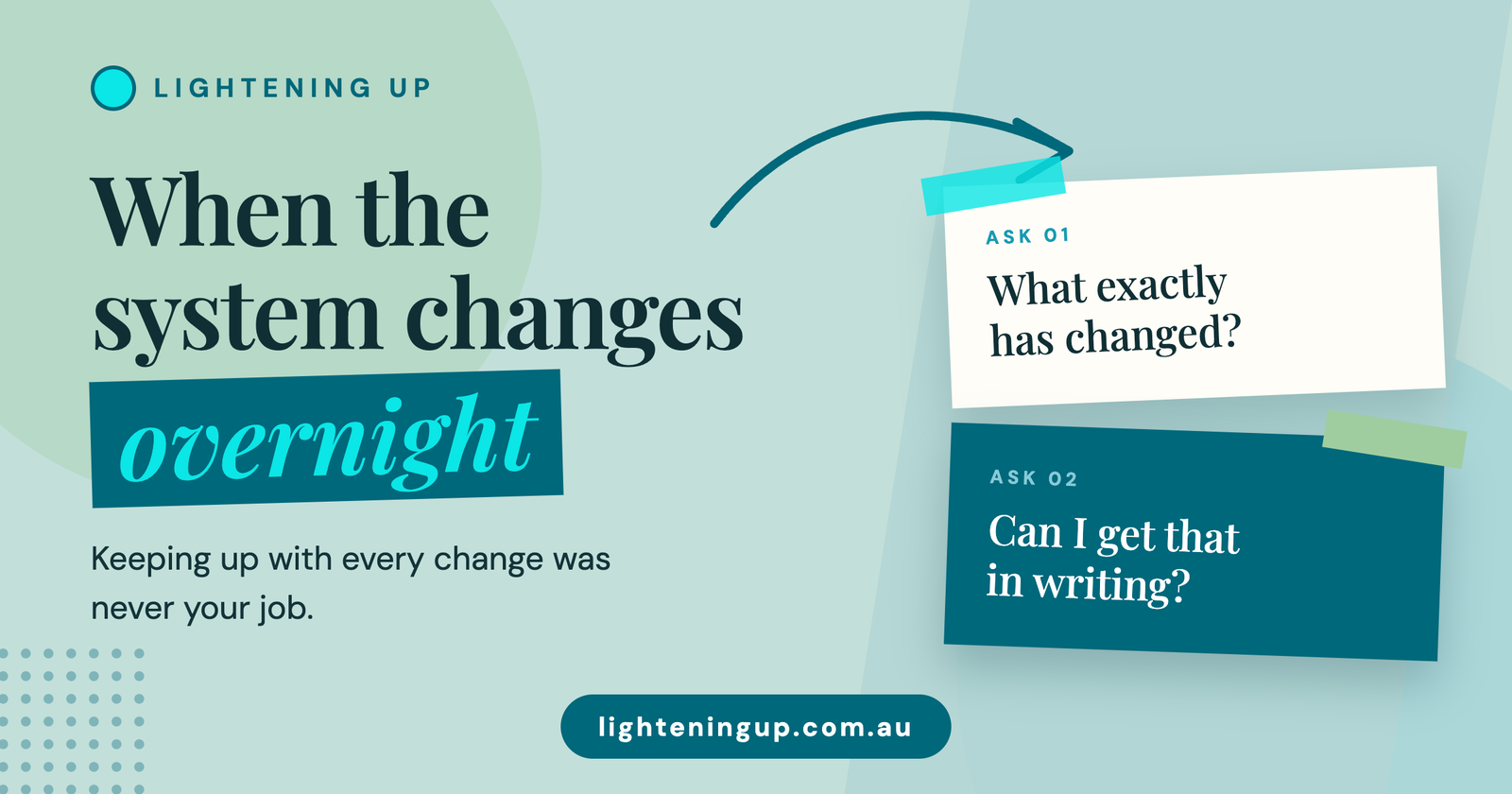
When Systems Change Overnight
You check your phone and something’s different. A rule that applied last month doesn’t apply the same way today. Nobody rang. Nobody sent a letter that actually made sense. You’re just expected to keep up.
If that’s ever left you feeling like you’re a step behind your own life, I want you to know you’re not imagining it, and you’re not the only one.
Why this matters right now
NDIS legislation changes a lot. Sometimes it’s small and technical, sometimes it changes what you’re entitled to or how a decision gets made about you. Most of us aren’t legal experts, and we were never meant to be. But when the ground keeps shifting under a system you rely on, it wears you down, and it’s easy to start thinking you’ve failed if you missed something.
Here’s what I keep coming back to. You were never meant to track every change yourself. That’s not you falling behind. That’s a system that owes people better communication than it gives.
How to tell what’s actually changed
Before you accept anything at face value, get clear on what’s real. Ask straight out, “has anything about my situation changed, and what exactly?” Don’t settle for a vague “policy’s different now.” Ask them to point you to the actual clause or update, not just their summary of it. Compare it to what you were told last time, and if it contradicts an earlier decision, say that out loud. And if you’re not sure what you’re looking at, that’s a completely reasonable thing to say too.
Five questions worth asking before you accept a decision
- What exactly has changed, and where is that written down?
- Why is this decision being made now, and by whom?
- What evidence or information was it based on?
- What are my options if I don’t agree?
- Can I get this in writing?
You won’t need all five every time. But even one of these can slow things down enough to protect you when a decision feels off.
What to ask for in writing
If a decision affects you, you’re entitled to have it in writing. That means the decision itself in plain language, the reason behind it, what rule or policy it’s based on, and who made it and how to appeal it. A conversation can shift in the retelling. A written record can’t be quietly walked back.
Keeping track when the advice doesn’t match up
At some point you’ll get two different answers from two different people. That’s common, not a sign you’re doing something wrong. Keep a simple record: the date, who you spoke to, what they said, and how (phone, email, in person). If it was a call, follow up with an email summing up what was said, so there’s a trail. And if the advice conflicts, name it plainly when you follow up: “I was told this by one person and that by another, can you tell me which is correct?” You don’t need a fancy system. A notes app or a plain notebook does the job. What matters is it exists somewhere outside your memory.
When to bring in advocacy support
You don’t have to wait until things have gone badly wrong. Reach out to an advocate when a decision doesn’t make sense and the explanations aren’t landing, when you’re being rushed into accepting something without time to think, when you’ve asked for something in writing and it hasn’t turned up, when the advice you’re getting keeps conflicting and you can’t untangle it on your own, or honestly, when you just don’t have the energy left to keep pushing. That last one is reason enough on its own.
Asking for support isn’t giving up on handling things yourself. It’s recognising that navigating a system built on constant change was never a solo job to begin with.
The bit that matters most
You do not need to understand the entire system. Nobody does, not even the people running it.
What you need is to understand what the change means for you. That’s it. Not the full legislation, not every clause, not the history of every amendment. Just what this means for your life right now, and what you need to do next.
Give yourself permission to let the rest go.
Madeleine x