Human Rights in the Age of AI: Who Protects You from an Invisible Decision?
Somewhere right now, a decision about your life might be getting made by software you’ve never seen, using rules nobody’s explained to you. Not a person weighing your situation. A system, quietly sorting, scoring, and deciding, while you wait to find out the result.
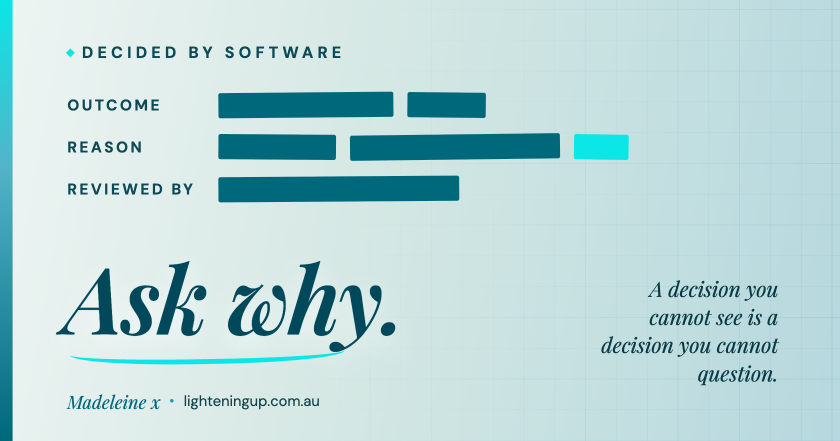
I don’t think AI is the enemy here. But a decision you can’t see is a decision you can’t question, and that’s the bit I want to sit with in this one.
Where this is already happening
Automated systems now sit inside health records, recruitment, payments, and access to services, often without much fanfare. A note gets summarised by AI before your doctor even reads it. A job application gets screened by software before a human eye lands on it. A payment gets flagged, delayed, or denied by a system running rules nobody explained to you upfront.
None of that is science fiction. It’s already woven through ordinary parts of a life, quietly enough that most people don’t notice it until something goes wrong.
The right to know when automation is in play
You should be told, plainly, when a decision affecting you was made or shaped by an automated system, not buried in fine print, but stated clearly enough that you’d actually notice it. Not knowing means you can’t ask the next obvious question: on what basis? If a system helped decide something about your care, your job, or your payment, that’s not a small detail. It’s the starting point for everything else.
Bias hidden inside scoring tools
Automated systems are built on data, and data carries the patterns of the world it was pulled from, including the unfair ones. A scoring tool can end up quietly disadvantaging the same groups who were already getting a worse deal before the tool existed, just dressed up as something neutral and mathematical. “The system decided” can sound more objective than it actually is. It’s still built by people, trained on choices people made, and it can still get things wrong in exactly the same patterns people do.
Explanations that actually make sense
An outcome isn’t accountable if nobody can explain how it was reached. If a decision affecting your life came out of an automated process, you’re entitled to an explanation that makes sense in plain language, not a shrug, not “that’s just what the system said.” A reason should be something you could actually respond to, not a locked box you’re expected to accept.
Human review and a way to correct things
Automation should never be the final word on something this important. There has to be a real path to a human review, someone who can look at your specific situation and actually change the outcome if it’s wrong, not just note your objection and move on. And if an automated decision turns out to have been mistaken, there needs to be a clear way to fix it, and to fix what that mistake may have already caused.
Who stays accountable when the technology fails
When something goes wrong, “the algorithm did it” can’t be where the conversation ends. A person or organisation put that system in place, chose what data trained it, and decided to rely on its output. That choice carries responsibility, and no amount of technical complexity should let anyone off the hook for a decision that affected someone’s actual life.
Where I land on this
I’m not asking you to distrust every automated system, or to fight technology for the sake of it. I’m asking you to keep asking the same question you’d ask a person: why was this decided, and can I challenge it. If a system can’t answer that, it hasn’t earned the trust it’s been given.
The bit that matters most
No decision affecting a person’s life should become impossible to understand, question, or challenge.
Technology can help carry the workload. It should never become the reason a decision sits beyond reach, unexplained and unchallengeable. Your right to ask why doesn’t disappear just because the answer now comes from a machine.
Madeleine x