When Choice Is Not a Real Choice
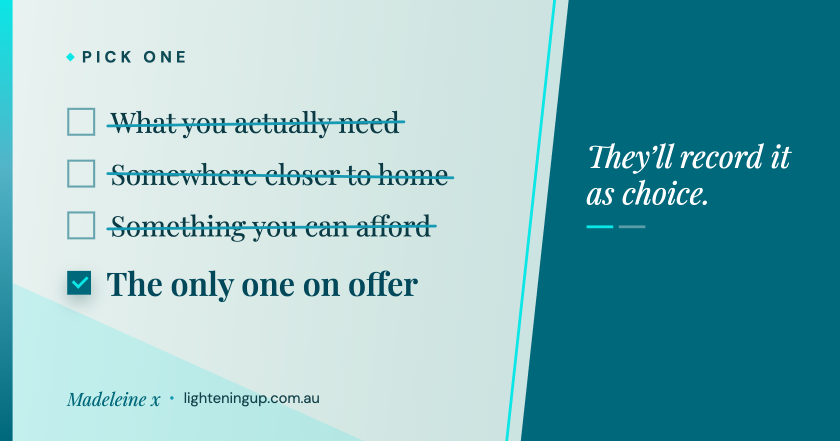
Systems love the word choice. You chose that service. You chose that provider. You chose to accept that plan. Said like that, it sounds like you picked freely from a full table of options. Often, what actually happened is you picked the least bad thing out of a very short list, because nothing else was on offer.
That’s not really choice. That’s damage control dressed up in the language of control.
Choice without real alternatives
A choice only means something if there’s something to choose between. If every option in front of you is unsafe, unaffordable, or simply not suited to your situation, then “choosing” one of them isn’t an exercise of control. It’s picking which version of a bad outcome you’re willing to live with.
Systems rarely name it that way. They record that a choice was made, tick the box, and move on. What they don’t record is that you spent the whole time looking for an option that didn’t exist.
What actually restricts control
A lot of this comes down to things well outside anyone’s power to change on their own. Funding that doesn’t stretch to the support that’s actually needed. A location with one provider, or none. Waitlists so long that whatever’s available now becomes the only realistic option, regardless of fit.
None of that is a personal failure to choose well. It’s a shortage being handed over as if it were a decision, and left for you to sort out on your own.
Consent versus resignation
These two can look identical from the outside and feel completely different on the inside. Consent is saying yes to something you actually want, or at least something you weighed against real alternatives. Resignation is saying yes because you’re exhausted, because there’s nothing else, because fighting for something better has already cost more than you have left to give.
A signature looks the same either way. What’s underneath it doesn’t.
Questions that expose a constrained choice
If you want to check whether a choice was real, a few questions do the work:
What else was actually available to me, not in theory, but genuinely accessible in my situation? What would I have chosen if cost, location, or waitlists weren’t a factor? Did I pick this because it was right for me, or because it was simply the only thing on offer?
If the honest answer to that last one is “the only thing on offer,” that’s worth naming out loud, even just to yourself.
What meaningful choice should include
Real choice needs more than one option that’s actually workable, not just legal or technically available. It needs enough information to weigh those options properly, in language that makes sense. It needs enough time to think it through without pressure to answer on the spot. And it needs the power to say no to all of it, without that refusal costing you the support you still need.
Take any one of those away, and what’s left starts to look like choice without actually being it.
The bit that matters most
Choosing the least harmful option is not the same as having genuine choice and control.
Surviving a bad set of options with the least damage possible is a skill, and often a hard-won one. But it’s not the same as having real power over your own life. Naming that difference isn’t ungrateful, and it isn’t giving up. It’s telling the truth about what “choice” has actually meant.
Madeleine x