Thoughts
Included but Still Not Valued: Why Being There Isn’t the Same as Belonging
· Madeleine Nicholas
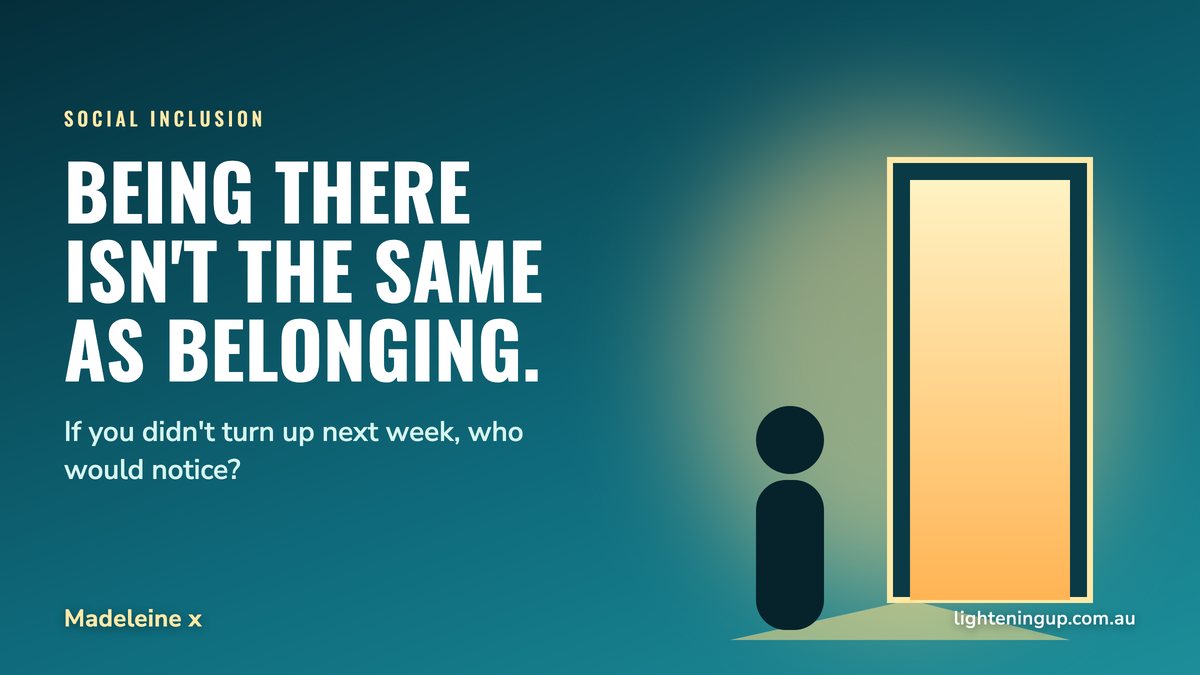
Is being included the same as belonging? No. You can be in the room and still not be known, needed or missed.
You can be at the workplace, the school, the club or the community group. You can have a name tag and a chair. And still be on the edge of everything.
I think that’s the part social inclusion talks skip. We count who turned up. We don’t ask what happened once they did.
What the numbers say
The Australian Institute of Health and Welfare reports that in 2021, 19% of people with disability aged 15 to 64 experienced social isolation, compared with 9.5% of people without disability. The same report found about 36% weren’t satisfied with their local community, compared with 25% of people without disability.
I read those figures as a gap in connection, not just a gap in getting out the door. People can be out and about and still not be part of anything.
Why roles matter so much
Social Role Valorisation is a long name for a simple idea: the roles you hold shape how people treat you. People in roles we respect, like colleague, neighbour, teammate or volunteer, tend to get more respect, more chances and more people who notice when they’re gone. People whose main role is “client” or “someone we support” often don’t. If you’d like the full explanation, I’ve written it in What Social Role Valorisation Means.
Attending isn’t the same as contributing. A seat at the table isn’t a job at the table. And a space that only welcomes you when someone else is paid to bring you isn’t a place you belong. It’s a place you get taken to.
A simple test
If you didn’t turn up next week, who would notice? Would anything stop?
Here are five questions to ask about any place, for yourself or for someone you support:
- Who here knows my name and something about me?
- Do I have a job in this place, something other people rely on?
- If I stopped coming, who would notice, and what would change?
- Do I see anyone from here outside of paid support?
- Do I give something here, or only get something?
If most of the answers are no, it doesn’t mean the place is bad. It means inclusion has stopped at the door.
What a valued role looks like
The next step is a role, not more attendance. Something small and real. Opening up. Running the raffle. Looking after the plants. Being the person who knows how the urn works. A role that someone would genuinely miss, because something would go undone without it.
Small roles like these grow. Once someone is relied on, people start asking their opinion, inviting them to things and noticing when they’re away. That’s what belonging is made of.
The bit that matters most
Real inclusion isn’t being allowed into the room. It’s having a valued place in it.
What role would you like to be missed for?
If you’d like to look at your own situation, try the Social Role Valorisation check in. It takes about three minutes and nothing is saved.
Madeleine x
Not sure where to start?
Take a three minute check-in, or grab the free Starter Kit.