Thoughts
A Score Decided I Was Low Priority Before Anyone Met Me
· Madeleine Nicholas
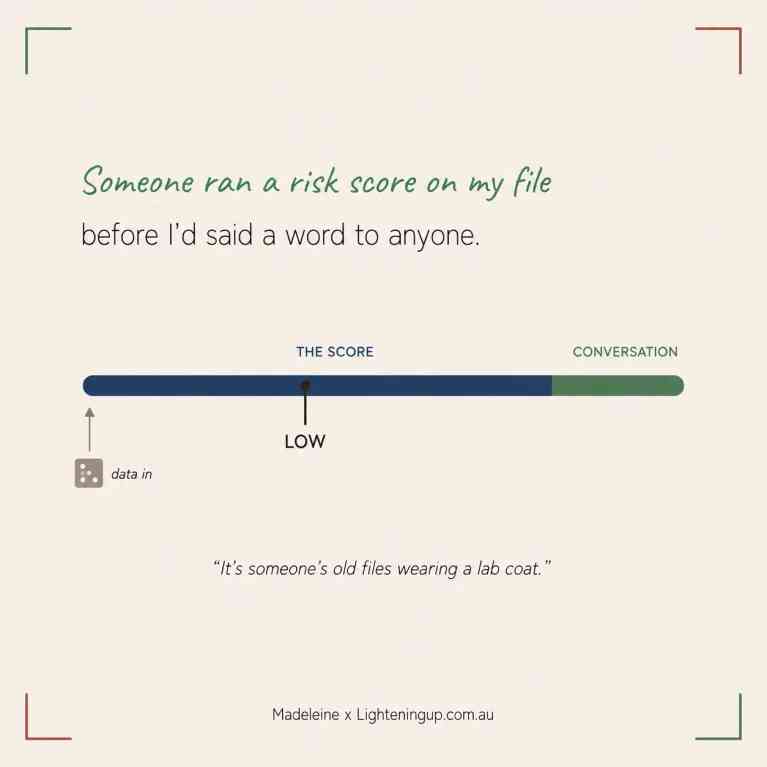
Before the conversation.
Before hearing my story.
Before understanding my circumstances.
An algorithm, a historical dataset, or a predictive model can influence how someone is viewed long before they have the chance to speak for themselves.
Data can be useful but it isn’t neutral. It reflects the systems, assumptions, and histories it was built from.
People deserve to be known for who they are today, not reduced to what old data predicts they might be.
Because no score should replace a conversation.
💚 Have you ever felt like a decision had already been made about you before anyone actually listened?
Someone ran a risk score on my file once before I’d said a word to anyone. Age, history, a few flags in a database, and out came a number that quietly decided how urgent my case was.
Most people have no idea how much of this happens before a human actually looks at them. These scoring tools exist to help services triage limited resources. Fair enough, resources are limited. But look at what they’re trained on. If the old data already under counted disabled people, women, anyone who’s ever had to fight to be believed, the score just inherits that same blind spot and hands it back out looking like neutral maths.
What gets me is how much confidence people put in a number over an actual conversation. A score feels objective. It’s not. It’s someone’s old bias wearing a lab coat. I’ve watched a low score close a door that five minutes of talking to me would have opened straight away.
Data can help services run better, I genuinely believe that. But a number should start the conversation, not replace it.
Has a score, an algorithm, or a form ever decided something about you before a person got the chance to?
If you’re ready to stop being reduced to a number, Self Advocacy Unleashed teaches you how to make sure the human conversation still happens. Join the waitlist, link in bio.
Madeleine x